
On Anti-Zionism and Antisemitism.


For starters, what is Zionism?
Zionism is a movement centered on Jewish national self-determination in the Jewish people’s ancestral homeland. The Jewish people hold an ancestral connection to the Land of Israel and have maintained a continuous presence there for over 2,000 years. Our longing to return has been with us since the exile, present in our holy texts and prayers, poetry and songs, our traditions and customs. Modern political Zionism emerged in the late 19th century, but its roots run far deeper. Our history of oppression and persecution has proven the need for Jews to live freely and securely in our homeland.
Israel is no longer just a dream Jews long for. It is a living, breathing country of more than 10 million people, including roughly 7 million Jews, nearly half of the world’s Jewish population. Many are descended from Jews who fled persecution in Europe, the Middle East, and North Africa, and Israel served as their refuge.
Jewish identity and Zionism are intertwined. Israel is rooted in Jewish history, tradition, and religious life: Our holidays, agricultural calendar, language, and collective memory all follow the rhythms of the Land of Israel, reflecting its longstanding place as the Jewish people’s ancestral homeland. The American Jewish Committee’s 2025 State of Antisemitism in America survey found that over three-quarters of American Jews consider caring about Israel important to what being Jewish means to them. Not all Jews are Zionists, just as not all Jews keep Shabbat or observe kashrut, but all three remain core to Jewish identity.
What is anti-Zionism?
Anti-Zionism is opposition to Zionism, the movement for Jewish national self-determination in our ancestral homeland. While anti-Zionism encompasses a range of political beliefs, it generally involves opposition to Israel’s existence as a Jewish state or rejection of Jewish national self-determination. Anti-Zionism is often expressed by denying Jewish nationhood, vilifying individuals or groups associated with Zionism, or negating historical Jewish ties to the region.
Criticizing Israeli government policies, political leaders, military conduct, or legislation does not, in itself, constitute anti-Zionism. In fact, many Zionists engage in regular criticism of Israel, out of love for the country and as part of a natural push to always strive for better. The distinction is between criticizing the state’s actions and opposing the legitimacy of its continued existence.
Criticism of Israel, anti-Zionism, and antisemitism are not necessarily interchangeable. Still, they often intersect.
Criticism Israeli policy or the Israeli government is not inherently antisemitic. No one acting in good faith would argue otherwise.
However, antisemitism targets Jews both as individuals and as a collective: synagogues, Jewish organizations, and yes, even the Jewish state. Israel itself can be a target of antisemitism, and criticism of it crosses the line when it relies on antisemitic tropes, holds Jews everywhere responsible for Israel’s actions, or applies standards to Israel that are not applied to any other country.
Likewise, calls to deny the Jewish people, and only the Jewish people, the right to national self-determination are often antisemitic.
Despite its true meaning, the word “Zionist” often is used as a pejorative in ways that have little to do with its actual meaning. What should describe a movement for Jewish self-determination has become a vehicle for antisemitic conspiracy theories and a pretext for excluding Jewish people. Let’s explore...
When “Zionist” becomes a substitute for “Jewish.”
The problem arises when “Zionists” becomes a proxy for Jews. For centuries, antisemites have accused Jews of controlling banks, governments, the press, and other institutions. Claims such as “Zionists control the media” or “Zionists run the government” reproduce the same conspiracy theories about a hidden Jewish collective exercising disproportionate control over society.
The same pattern can appear in exclusionary demands directed at Jews. Statements like “we don’t want Zionists here” are used to exclude Jewish students or demand that Jewish students first demonstrate that they are “not Zionists” before being accepted as legitimate participants. This is an ask for Jewish students to check their identities at the door, disavowing a belief or connection that is fundamental to Jewish identity before they are permitted to participate as equals. Jewish students should not have to pass an ideological test, prove that they are the “right kind” of Jew, or distance themselves from Israel and Zionism in order to be welcomed into a campus community.
This distinction matters particularly on college campuses, where debates about Israel and Zionism overlap with Jewish student life. New York University has explicitly recognized in its ‘Guidance and Expectations on Student Conduct’ that “Zionist” can function as a proxy for Jews or Israelis. Among the examples it discusses are excluding Zionists from otherwise open events, calling for the death of Zionists, imposing a “no Zionist” test for participation, and promoting conspiracy theories such as claims that “Zionists control the media.”
What about the term, “Zio?”
One antisemitic dog whistle is the shortened form “Zio,” which has a documented history as a derogatory expression, particularly in extremist and conspiratorial contexts. Former Ku Klux Klan leader David Duke used “Zio” extensively in his political writing and broadcasting, incorporating it into expressions such as “Zio-Communism,” “Zio-economics,” “Zio-history,” “Zio-supremacism,” “Zio-Occupied America,” and “Zio-Occupied Government (ZOG).” The term has subsequently appeared in other controversies. In 2016, the UK Labour Party’s inquiry into antisemitism specifically identified epithets such as “Zio” as having no place in Labour discourse. In 2017, organizers of the Chicago Dyke March used the phrase “Zio tears” before apologizing and acknowledging the term’s history.
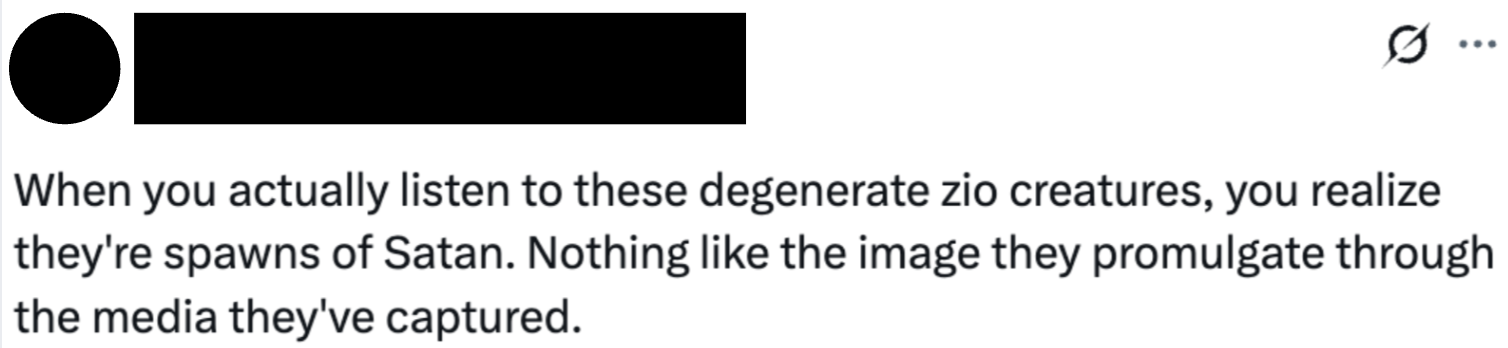
Posted on X (Formerly Twitter). Screenshot from Jewish on Campus researcher.
What Zionism means to Jewish on Campus.
“Jew” and “Zionist” are not synonymous. Being Jewish encompasses religious life, ancestry, culture, history, and peoplehood, while Zionism is centered on Jewish self-determination in the Jewish people’s ancestral homeland. But the two are inextricable: the Land of Israel is deeply woven into our history, traditions, prayers, holidays, language, and collective memory. We are proud to be Zionists and affirm the Jewish people’s right to self-determination in our homeland.
Our Zionism does not mean that we agree on every Israeli policy or political question, nor does it define the entirety of our Jewish identity. For us, it’s an expression of our connection to our people, our history, and our ancestral homeland.
At Jewish on Campus, we are proud to be Jewish, and we’re proud to be Zionists.