
Holocaust Denial 101.
Understanding Holocaust Denial and Distortion.
The Holocaust, or Shoah, was the systematic, state-sponsored persecution and murder of six million European Jews by Nazi Germany and its allies and collaborators between 1933 and 1945. Understanding the Holocaust means understanding how the Nazis attempted to conceal and erase evidence of their crimes, and how similar patterns of denial and distortion continue today.
The Holocaust involved an extensive system of government and societal institutions. Every branch of the Nazi German government and many German institutions became involved in the persecution and annihilation of Jews and others. The Finance Ministry participated in confiscating Jewish property and wealth. Churches provided birth records that could be used to identify Jews. Universities and academics were brought into conformity with Nazi ideology, with curriculum required to reflect Nazi racial and political beliefs.
Auschwitz. Dachau. Treblinka. Bergen-Belsen. Ravensbrück.
The Nazi regime and its collaborators established more than 44,000 sites of incarceration—ghettos, forced-labor camps, detention centers, concentration camps, and killing centers—across Europe. Two-thirds of Europe’s Jews were murdered in camps, riots, and shootings. The Holocaust also affected Jewish communities beyond Europe. Nazism inspired the Farhud, a 1941 pogrom in Iraq in which hundreds of Jews were killed.
Holocaust denial began during the Holocaust itself, when the Nazis attempted to conceal their crimes while committing them.
The Nazis presented Theresienstadt (Terezín) as a “model ghetto,” using propaganda and a staged 1944 Red Cross inspection to portray relatively normal Jewish life. In reality, starvation, disease, abuse, and death were widespread; more than 33,000 Jews died there, while most others were deported to extermination camps. At Babi Yar (Babyn Yar), Nazi German forces and collaborators murdered more than 33,000 Jews in September 1941, with tens of thousands more Jews and non-Jews killed there afterward. In 1943, the Nazis forced prisoners to exhume and burn the bodies to destroy evidence. In his 1943 Posen Speech, Heinrich Himmler emphasized the secrecy surrounding the mass murder of Jews, referring to it as a “glorious chapter” that was not to be publicly discussed.
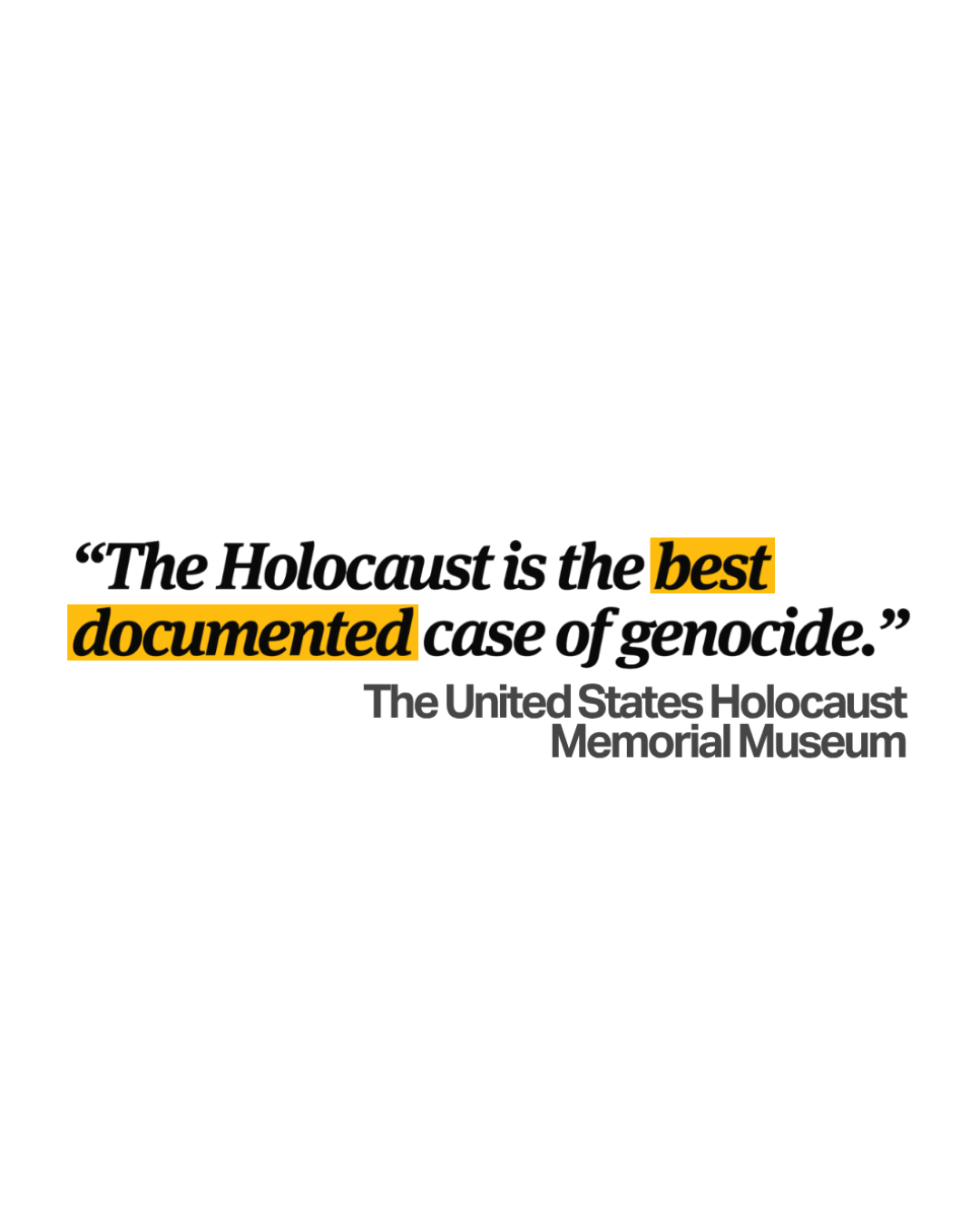
Despite Nazi attempts to distort the truth and manipulate the outside world, the Holocaust is one of the most extensively documented genocides in history. The German government and Nazi organizations created extensive records documenting their plans. Thousands of survivor testimonies, photographs, films, physical sites, and other forms of evidence provide additional documentation.
Holocaust denial is not limited to someone saying, “The Holocaust never happened.”
Denial can take different forms. Some explicitly reject the historical record, while others accept that Jews were persecuted and murdered but minimize the scale or severity of the Holocaust, distort its meaning, or make comparisons that undermine its historical specificity. These approaches can be divided into two broad categories: hardcore Holocaust denial and softcore Holocaust denial. They are not mutually exclusive; different forms can coexist within the same rhetoric.
Hardcore Holocaust denial is the claim that the Holocaust did not happen at all. Hardcore denial can take several forms:
The “Holohoax” theory falsely claims that the Holocaust was fabricated or dramatically exaggerated.
Claims that Jews invented or fabricated the Holocaust, often drawing on broader antisemitic ideas about Jews as dishonest, manipulative, or secretly controlling the world.
Another form claims that the Nazis’ “Final Solution to the Jewish Question” was merely a plan to deport Jews from the Third Reich rather than a program to exterminate European Jews.


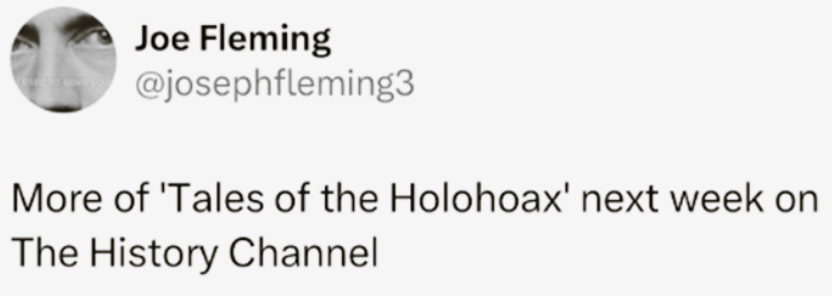
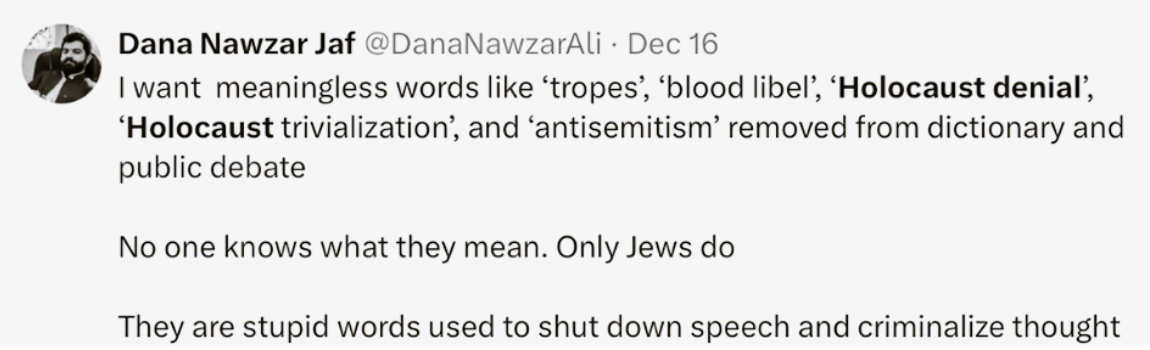
Posted on X (Formerly Twitter). Screenshots from Jewish on Campus researcher.
Holocaust denial does not need to be logically consistent. Its underlying premise is false.
Softcore Holocaust denial can be more difficult to recognize. Rather than explicitly rejecting the Holocaust, it twists or distorts its historical reality. It commonly appears in three forms: Holocaust minimization, Holocaust equalization, and Holocaust inversion.
These categories can overlap with one another and with hardcore denial.
Holocaust minimization diminishes the Holocaust's severity, scale, meaning, or historical significance.
The Historikerstreit, or “historians’ dispute,” frames the Holocaust as a reaction or counteraction to the Bolshevik Revolution, shifting attention away from the specific character of Nazi antisemitism and genocide.
Holocaust revisionism, which attempts to correct the standard interpretations of the Holocaust’s actual severity.
The number “271k” is presented as evidence that only approximately 271,000 people died during the Holocaust. In reality, the figure comes from a specific file recording a non-comprehensive number of deaths in certain concentration camps.
The “cookie” meme depicts Cookie Monster and cookies in an oven and argues that it would have been mathematically impossible to murder six million Jews using the number of ovens supposedly available.
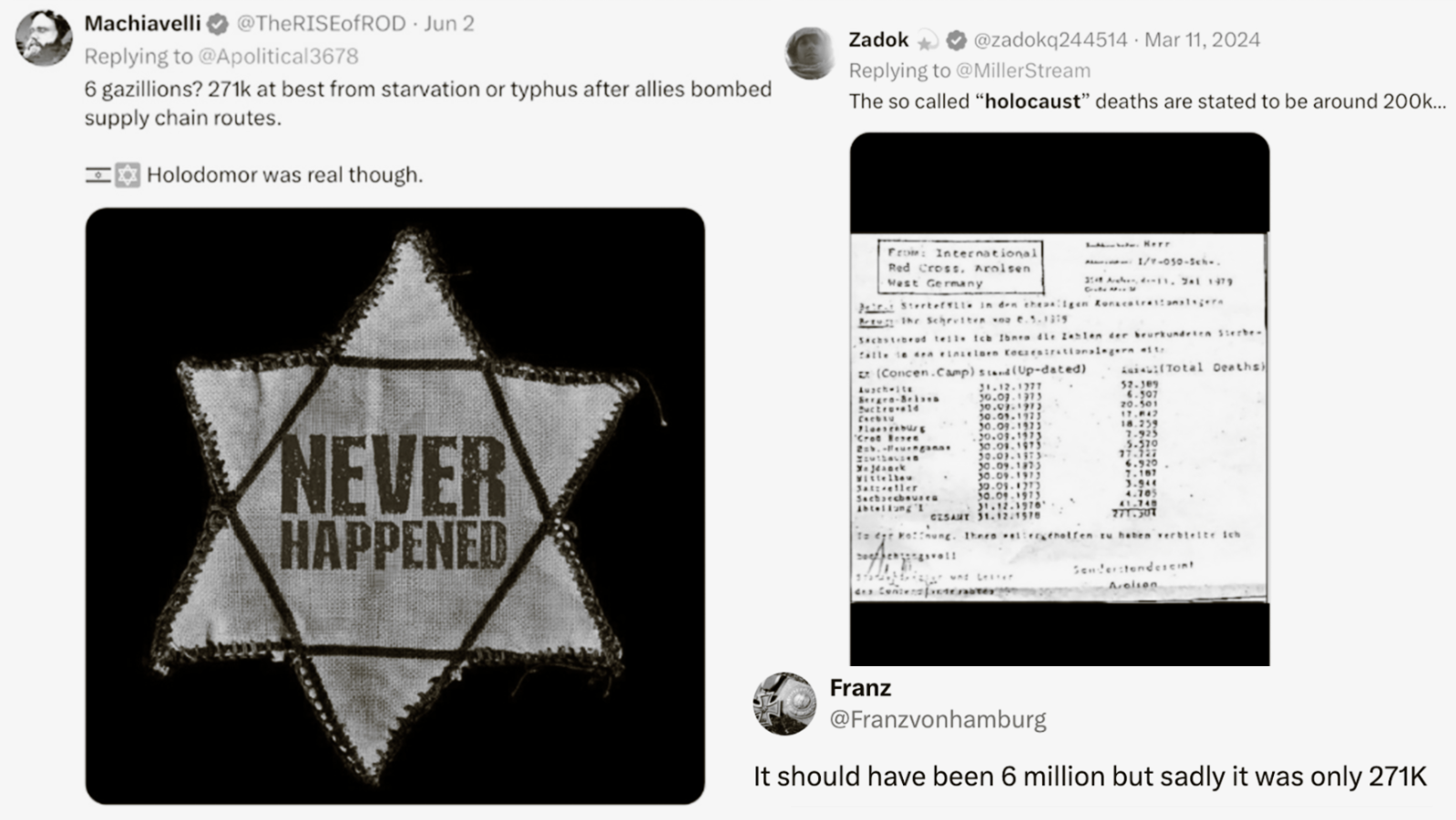
Posted on X (Formerly Twitter). Screenshots from Jewish on Campus researcher.
Holocaust equalization compares the Holocaust to other movements, events, or issues in ways that advance an outside agenda.
Historical events can certainly be compared, but equalization can erase the particular circumstances of the Holocaust and diminish its systematic, antisemitic, and widespread nature. Comparisons can include the Holocaust and September 11, abortion, animal experimentation, or claims about “comparable Allied wrongs” during the Second World War.
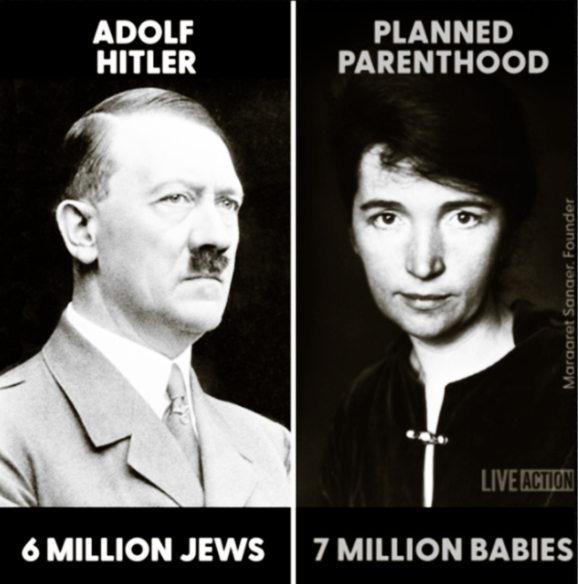
Posted on Instagram. Screenshots from Jewish on Campus researcher.
Holocaust inversion turns the reality of the Holocaust on its head, portraying Jews or Israelis as modern-day Nazis or Zionism as equivalent to Nazism. It can also portray other groups as the “new Jews” and their opponents as the “new Nazis.” Examples include:
Describing Jews or Israelis as modern-day Nazis.
Describing Zionism as Nazism.
Equating Gaza with Nazi-established Jewish ghettos.
Likening the Israel-Hamas War directly to the Holocaust.
Comparing contemporary Israeli policy or the Israel-Hamas War to the Holocaust.
Comparing the Intifadas to the Warsaw Ghetto Uprising.
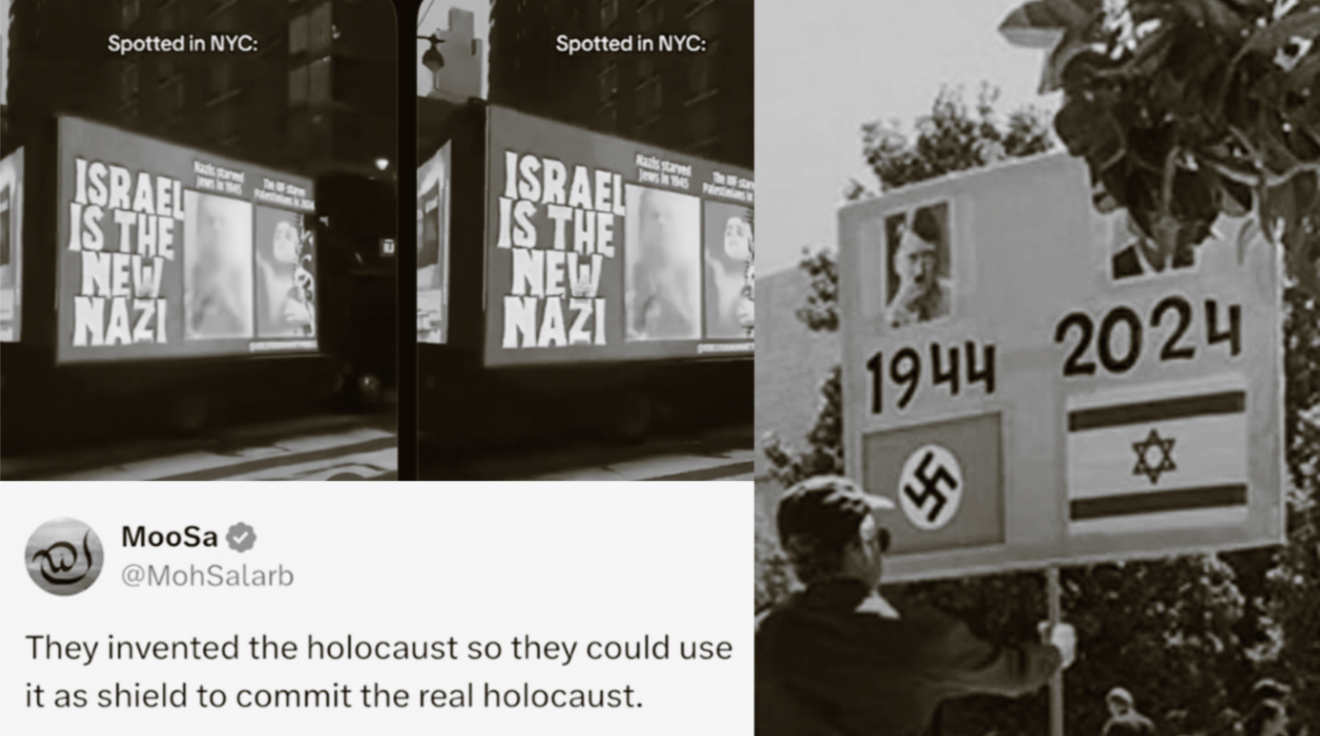
Posted on X (Formerly Twitter). Screenshots from Jewish on Campus researcher.
Holocaust denial has also attempted to present itself as legitimate academic inquiry. Paul Rassinier, a former political prisoner at Buchenwald, became known as the “father” of contemporary Holocaust denial. In 1977, David Irving published Hitler's War, arguing that Adolf Hitler was uninvolved in the genocide of six million Jews. The following year, the Institute for Historical Review (IHR) was founded in California to promote Holocaust denial under the guise of historical inquiry. In 1991, a former IHR employee founded the Committee for Open Debate on the Holocaust, which placed Holocaust-denial advertisements in college newspapers.
Holocaust denial and distortion have found new distribution channels through social media.
A 2022 UNESCO study found that 16.2% of Holocaust-related social media content denied or distorted the Holocaust. On Telegram, the proportion was even higher: 49%.
Social media can also turn Holocaust distortion into entertainment. In 2020, a TikTok trend involved users playing “dress up” as Holocaust victims, recreating features associated with victims such as sunken cheeks, eye bags, yellow stars, and striped clothing. Such trends can trivialize and minimize the Holocaust even when participants do not explicitly deny that it happened.
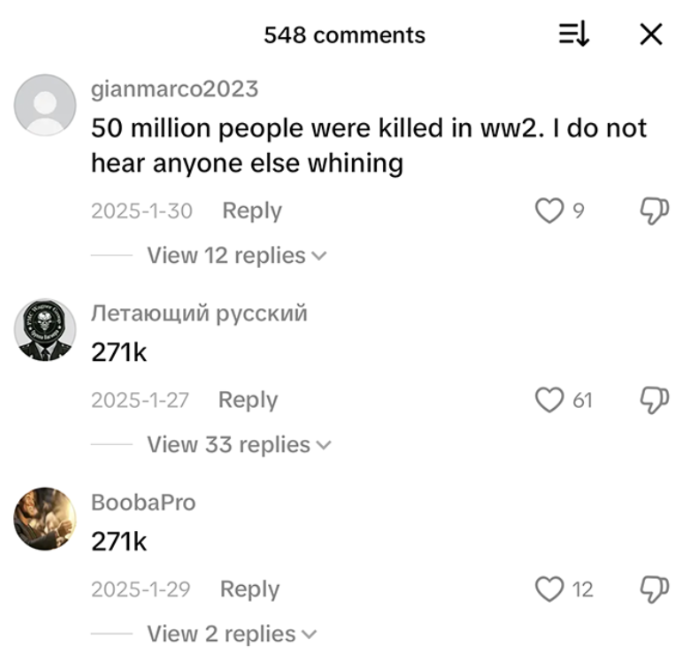
Comments underneath a Jewish on Campus TikTok video about International Holocaust Remembrance Day (2025).
Holocaust denial has consequences beyond historical disagreement.
It fuels antisemitism by portraying Jews as dishonest, manipulative, or collectively responsible for a fabricated narrative. It erases the experiences of millions of Jews who were murdered and millions more who suffered persecution, displacement, imprisonment, starvation, and loss. It can also strengthen broader conspiracy theories and extremist movements that undermine facts, evidence, and reason. When the historical record itself is treated as a theory, evidence becomes easier to dismiss and prejudice easier to rationalize.
So, what can I do?
Again, Holocaust denial isn’t always as obvious as someone saying, “The Holocaust never happened.”
Learn to recognize its less obvious forms. Call out Holocaust denial and distortion, including minimization, equalization, and inversion. Be especially vigilant when Holocaust-related language appears in memes, jokes, social media trends, conspiracy theories, or supposedly provocative historical questions.
Educate yourself and others. The Holocaust is one of the most thoroughly documented and systematically organized genocides in history. Extensive evidence is accessible through reliable historical and educational institutions. Learning the history makes it easier to recognize when it is being denied, distorted, trivialized, or turned upside down.
For further education and research, consult resources from:
United States Holocaust Memorial Museum
Yad Vashem
UNESCO
International Holocaust Remembrance Alliance
Anti-Defamation League
American Jewish Committee
Holocaust education resources and archival collections
The historical record is extensive. Holocaust denial does not arise from a lack of evidence; it arises from rejecting or distorting evidence that is already overwhelmingly available.