
On Soviet Antisemitism: Then and Now
For more than a century, antisemitism in the Russian Empire and Soviet Union evolved alongside changing political ideologies while drawing on longstanding prejudices. From tsarist restrictions to Soviet campaigns, authorities portrayed Jews as threats to national unity and enemies of the state.
Before the Soviet Union: Jewish Life Under the Russian Empire.
Ashkenazi communities across Eastern Europe lived alongside distinct Jewish communities in the Caucasus, Central Asia, and Crimea, including Mountain Jews, Georgian Jews, Bukharan Jews, and Krymchaks. Under the Russian Empire, discriminatory laws, residential restrictions, and recurring anti-Jewish violence shaped Jewish life. Often classified as the Russian term inorodtsy (“aliens” or “foreigners”), Jews faced restrictions on residence, education, occupations, and civil rights.
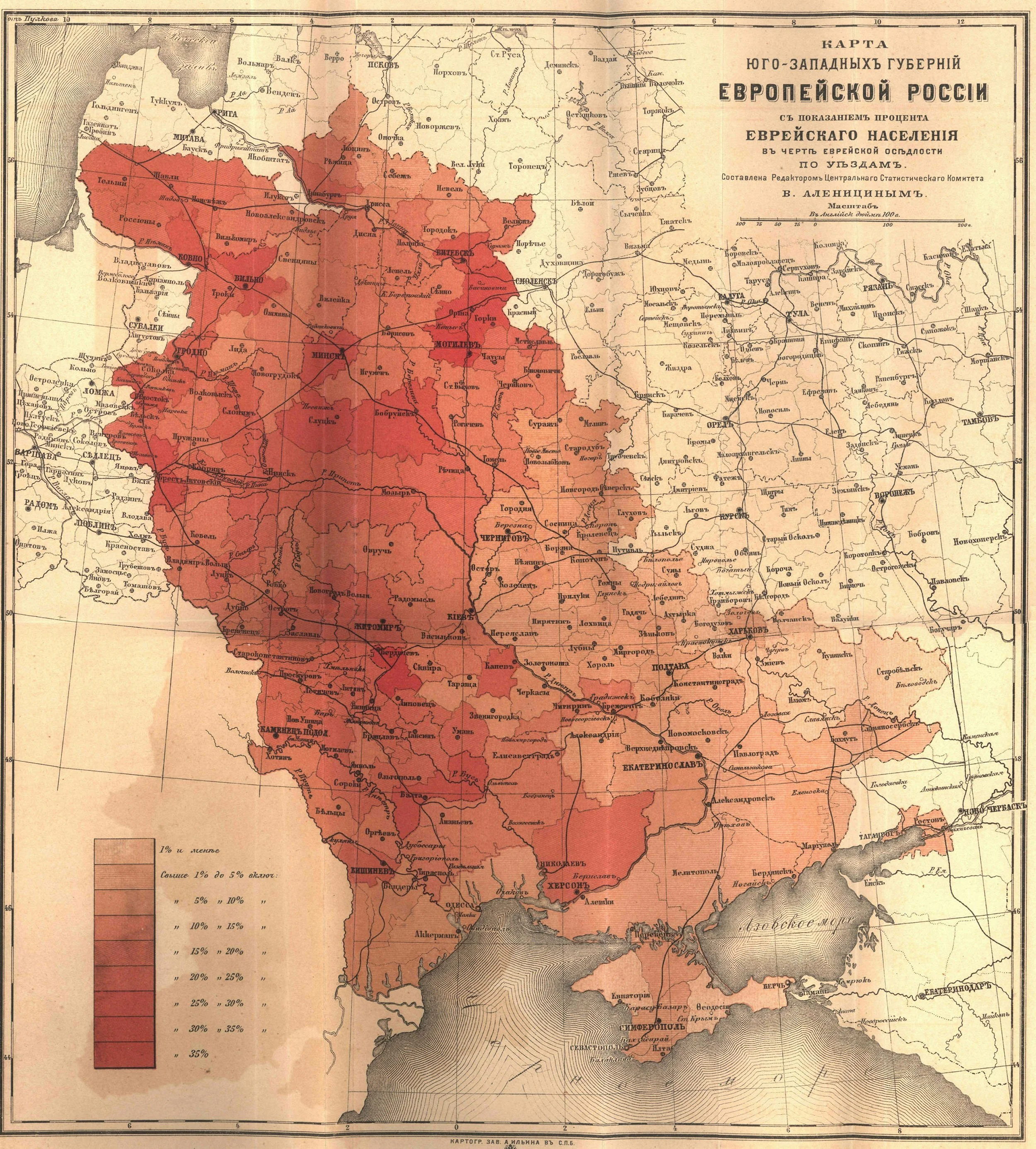
The Pale of Settlement. Beginning in the late eighteenth century, imperial authorities increasingly restricted Jewish residence to a designated region of the western Russian Empire known as the Pale of Settlement. Restrictions on residence, education, occupations, and civil rights limited Jewish opportunities, though rules and exemptions changed over time.
Forced assimilation and military conscription. Under Tsar Nicholas I, an 1827 decree subjected Jewish males to compulsory military service and allowed boys as young as 12 to be recruited. Many Jewish minors entered military preparatory institutions known as cantonist schools, where Jewish practice was often restricted and pressure to convert to Russian Orthodoxy was common.
Pogroms. Anti-Jewish riots known as pogroms involved assaults, killings, sexual violence, and the destruction of homes and businesses. In April 1903, the Kishinev pogrom killed 49 Jews, injured hundreds, and devastated the local community. In the weeks preceding the violence, antisemitic newspaper coverage spread false accusations, including blood libel—the centuries-old antisemitic myth that Jews murder non-Jews, particularly Christian children, to use their blood in religious rituals. These accusations stoked public hostility and were used to justify violence against Jewish communities.
The Protocols of the Elders of Zion. First published in the Russian Empire in 1903, this was a fabrication purporting to expose a secret Jewish plot to control governments, finance, media, and world affairs. Translated and circulated internationally, it became a foundational text of modern antisemitic propaganda and influenced Nazi propagandists. Its premise of Jewish domination continues to shape conspiracy theories today.
Many of the antisemitic ideas that circulated under the Russian Empire were adapted to new political contexts, repackaged in Soviet propaganda, and continue to resurface today. On college campuses, familiar tropes can appear in contemporary language: accusations of secret Jewish influence, suspicions of divided loyalty, and the attribution of collective responsibility to Jews for the actions of Israel. These narratives are not new.
Revolution and the Suppression of Jewish Life.
The Russian Revolution of 1917 overthrew the tsarist system and promised a new social order. The Provisional Government abolished legal restrictions on Jews, and the Bolsheviks formally prohibited antisemitic incitement. Yet the Soviet state’s suppression of religious institutions, Jewish nationalism, and independent communal life created new forms of repression.
Soviet policy was contradictory. During the 1920s, the state supported certain forms of Jewish-language education and secular culture while suppressing religious practice and activity beyond Communist Party control. This reflected the regime’s ideological and political priorities: Judaism and other religions challenged its official atheism, while Zionism and independent Jewish communal life were viewed as competing sources of identity and loyalty that threatened Soviet political control and unity. From the late 1920s onward, repression intensified, reaching new heights under Stalin in the 1930s and late 1940s. The government promoted atheism and dismantled religious institutions, including synagogues, religious schools, and communal organizations.
The Yevsektsiya: Communist control of Jewish life. Established in 1918, the Jewish sections of the Communist Party sought to extend Communist rule into Jewish communities. Guided by the regime’s atheism and opposition to independent political and national loyalties, they campaigned against religious institutions, Zionist organizations, Hebrew education, and independent Jewish political life. Synagogues and religious schools were closed or restricted; Jewish activists faced harassment and imprisonment. Public anti-religious events sought to ridicule religious belief and undermine traditional Jewish authority. The broader goal was to dismantle independent Jewish institutions and replace them with state-controlled, secular alternatives.
The assault on Hebrew and Zionism. Soviet authorities treated Hebrew-language religious education and Zionist organizations as politically suspect. While Hebrew education and Zionist organizing were suppressed, state-sponsored secular Yiddish institutions initially offered a limited alternative. This was not simply a campaign against religion; it was an effort to bring Jewish cultural expression under state control.
Birobidzhan: A Soviet alternative to Zionism. In 1928, the Soviet government designated a region in the Russian Far East for Jewish settlement; it became the Jewish Autonomous Oblast in 1934. The project promoted secular, Yiddish-speaking Jewish life within the Soviet system but never became the center of Soviet Jewish life. Stalin’s Great Purges of the late 1930s devastated Jewish intellectual and cultural life, with Jewish cultural leaders arrested or executed and institutions closed. In the late 1940s and early 1950s, the Soviet regime intensified its explicitly anti-Jewish repression, dismantling the remaining Yiddish cultural institutions and targeting Jewish writers, intellectuals, and members of the Jewish Anti-Fascist Committee.
Stalin and Jewish Identity.
Under Stalin, campaigns against alleged political enemies increasingly intersected with antisemitism. Jewish intellectuals, writers, scientists, and public figures faced accusations of disloyalty, foreign influence, and conspiracy. These charges exploited antisemitic stereotypes while advancing the state’s broader efforts to control public life.
Political purges, conspiracy accusations, and repression of dissidents. Soviet political campaigns portrayed opponents as traitors, foreign agents, and conspirators. Leon Trotsky, a prominent Bolshevik revolutionary of Jewish background and Red Army leader, was expelled from the USSR and assassinated by a Soviet agent in Mexico in 1940. The label “Trotskyist” became a state accusation of counterrevolutionary plotting, invoking longstanding antisemitic tropes of Jewish disloyalty and conspiracy. Millions were imprisoned in the Soviet Gulag, including Jewish religious figures, Zionist activists, and Hebrew teachers. Jewish dissidents also faced forced labor, surveillance, and other forms of repression.
The “rootless cosmopolitan” campaign. In the late 1940s and early 1950s, Soviet propaganda accused people of insufficient patriotism or excessive attachment to foreign culture. The campaign targeted Jewish intellectuals and cultural figures, drawing on the antisemitic trope of dual loyalty: the false accusation that Jews are inherently less loyal to their country of citizenship and more loyal to foreign powers or interests. Newspapers, caricatures, and satirical publications reinforced these stereotypes by portraying alleged cosmopolitans as outsiders whose supposed foreign allegiances threatened Soviet society.
The destruction of Jewish cultural leadership. During World War II, the Soviet government supported the Jewish Anti-Fascist Committee, which mobilized international Jewish support for the Soviet war effort. After the war, the state turned against the committee, arresting and torturing its leaders and associates and accusing them of nationalism and espionage. Thirteen defendants were executed in August 1952 in what became known as the Night of the Murdered Poets.
The Doctors’ Plot. In January 1953, Soviet authorities announced that a group of doctors, many of them Jewish, had allegedly conspired to murder Soviet leaders. The accusations revived the image of Jews as secret enemies operating within institutions of power. Stalin’s death in March 1953 brought the campaign to an abrupt halt, and the accused doctors were exonerated.
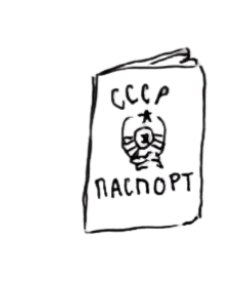
The “fifth point.” Soviet internal passports recorded a citizen’s nationality, meaning ethnic background. For Jews, the designation was generally еврей (yevrey, meaning Jew). Known as the “fifth point,” or pyataya grafa, this designation facilitated discrimination in university admissions, employment, professional advancement, and some state institutions.
Anti-Zionism as State Propaganda.
In 1948, Stalin’s government recognized Israel and initially viewed the new state as a possible means of weakening British influence in the Middle East. As Israel developed closer ties with the United States and other Western countries, Soviet policy shifted toward opposition.
By the late 1960s and especially during the 1970s, Soviet propaganda portrayed Zionism as imperialist, racist, or fascist, recasting Jewish national self-determination as an inherently illegitimate political project. These narratives draw on antisemitic tropes of Jewish power, manipulation, and disloyalty and persist today, including on college campuses, where rhetoric portrays Zionism itself as racist or colonialist.
The persecution of Jewish national expression. Zionist organizations, Hebrew education, and efforts to emigrate to Israel were treated as threats to Soviet authority. Jewish identity could be tolerated only within boundaries set by the state. Across the USSR, underground Hebrew teachers and students also faced pressure as they worked to preserve the language and maintain connections to Jewish culture and Israel.
The campaign against emigration. Faced with persecution, many Soviet Jews sought to emigrate, but were often refused permission to leave. These people became known as refuseniks and faced professional retaliation, surveillance, harassment, or imprisonment. Their plight galvanized an international movement for Soviet Jewry, including the Student Struggle for Soviet Jewry, founded in 1964, which organized demonstrations and campaigns to pressure the Soviet government to permit emigration. Activists helped make Jewish emigration a major human-rights issue and a point of contention in Cold War diplomacy. Human-rights activist and prominent refusenik Natan Sharansky was arrested in 1977 and sentenced in 1978 on charges including treason and anti-Soviet activity. His case became a focus of international advocacy. As Soviet emigration restrictions eased in the late 1980s, hundreds of thousands of Jews left the USSR, many immigrating to Israel.
The international campaign against Zionism. In 1975, the UN General Assembly adopted Resolution 3379, declaring Zionism a form of racism and racial discrimination. The resolution was revoked in 1991 by Resolution 46/86. The Soviet Union supported the campaign as part of its broader Cold War alignment. United Nations: Resolution 3379
Exploiting racial tensions abroad. During the Cold War, Soviet intelligence covertly sought to pit Black and Jewish Americans against one another. In 1971, the KGB launched Operation PANDORA, a plot to intensify racial conflict by planting explosives near a predominantly Black institution and falsely attributing the attack to the Jewish Defense League. Soviet operatives also paid agents to paint swastikas on synagogues and desecrate Jewish cemeteries and then make anonymous phone calls claiming they were the work of Black activists.
Then and Now.
Antisemitic narratives endure because they adapt to new political contexts, audiences, and platforms. On college campuses, longstanding tropes about secret Jewish control, divided loyalties, and collective responsibility are repackaged in the language of contemporary political movements, allowing old prejudices to circulate in new forms.

Contemporary Russia continues to exploit antisemitic conspiracy theories to discredit its adversaries, distort events, and sow division in Western societies. Iran, too, has used similar tactics. A 2026 report from the Simon Wiesenthal Center details how Iran has waged a thirty-year “soft war,” weaponizing antisemitism to unite far-left anti-imperialists, far-right isolationists, Black nationalists, and religious extremists. Built through offline networks like the sanctioned Hollywoodism and New Horizon conferences (which popularized tropes like the Deadly Exchange), this infrastructure is now amplified digitally through covert state media, AI fake news, synthetic personas, Wikipedia manipulation, cyber operations, and apocalyptic eschatological messaging.
We should not flatter ourselves into thinking that our technological advancement is on par with human progress, or that all social justice moves at the same pace. In many ways, our incredible innovation has also innovated humanity’s oldest bigotry.
In 2016, Rabbi Sacks delivered a keynote address entitled “The Mutating Virus: Understanding Antisemitism” in the European Parliament. He said, “It is easy to hate, but difficult publicly to justify hate. Throughout history, when people have sought to justify antisemitism, they have done so by recourse to the highest source of authority available within the culture.”
Rabbi Sacks’ wisdom endures, more than a decade later. Antisemitism is remarkable in its ability to adapt. Though the Soviet Union is long gone, the antisemitic theories it propagated continue to fester, mutate, and find new audiences.